YES - you can eat an avocado if the pit is growing a root. Most Hass avocados won't grow a root inside the avocado (its a long story -- it has to do with when they are harvested, how long they stay in cold storage, how they gas them to ripen right before they are taken to the grocery store, etc...)
My avocados often grow roots inside the avocado. That's because they are picked and shipped within 48 hours. They are still growing, living fruit when we ship them to you. Often, the varieties I'm shipping you are "closer" to the original avocado - (not as highly hybredized) - so they are more "natural" and prone to reproducing themselves. So they often grow roots. Not ALL my avocados do that (for example, the LAMB avocado is a grand daughter of the Hass -- so its even less prone to grow roots). But most of what we ship is "fore runners" of the Hass.
So, are they safe to eat? YES -- you can eat an avocado that is growing roots on the pit. Simply take the pit out (it may crack in half - that is normal too.) Cut out any root bits that get stuck in the avocado's flesh (they are tough and bitter - but not harmful). Then eat the avocado as usual.
If you want to grow a house plant - these pits with roots already growing are GREAT! They almost always grow into a plant.
Here is a video about how to grow that pit into a plant!
Best wishes! The Avocado Diva
Monday, November 18, 2013


Friday, August 24, 2012

Monday, August 13, 2012
Pickled Avocados
Do you ever find yourself with too many ripe avocados on your hands? Or perhaps you see them for sale at the store or a road side stand and wish you could take advantage of that opportunity?
If you do -- here's something to try -- you might find yourself a way to enjoy some avocados in mid-winter by preserving them with an old fashioned method - pickling! Let us know if you try it and how it works out for you.
 |
| Cut up summer avocados - pre pickled |
PICKLED AVOCADOS - RECIPE
Pickling a fruit is a time honored way to preserve it for future enjoyment. I've experimented with pickling avocados in the 'fridge and they turn out salty and vinegary with a garlic hit as well as a small kick from the chili. It's an excellent way to take advantage of those opportunities when a neighbor gives you extra avocados OR you find them on sale in the market.
INGREDIENTS:
2 or 3 ripe (but not too ripe) avocados
1/2 cup red wine vinegar
1/3 cup chopped cilantro
2 tablespoons sugar
1 1/2 teaspoons kosher salt
1 or 2 cloves of garlic, sliced
1 jalapeño pepper, de-seeded and sliced thinly
DIRECTIONS:
1. In a saucepan over medium heat combine all ingredients EXCEPT for the avocados and bring to a boil for about 2 minutes, stirring to make sure sugar and salt is dissolved.
2. Cool mixture to room temperature (in fridge or on counter).
3. When the pickling liquid is cool, peel and pit your avocados. You can leave in large chunks, or in whole slices - your choice.
4. Put the avocado into a shallow dish and pour the pickling liquid over it. Cover tightly with plastic wrap and place in refrigerator overnight.
5. The avocados are ready to eat the next day -- and can last a long time in the refrigerator, in a covered jar, plastic bowl with lid, etc.
SERVING SUGGESTIONS:
1. The pickled avocados are delicious on their own!
2. You can also serve them like you would pickled cucumbers or olives - on an appetizer plate with other fresh and pickled veggies.
 |
| Post pickle - after being in 'fridge overnight |
3. They are delicious served on top of toasted sour dough bread or French bread.
4. Pickled avocados are excellent on top of a lettuce salad. Mix some of the pickling liquid with avocado oil or olive oil for a dressing.
Monday, June 18, 2012
New World Chicken


In this one pot meal, we will use avocado oil, avocado leaves and finish with chopped avocado (instead of sour cream).
Avocado oil has a very high smoke point – so the benefits of
the oil are not lost when cooking with it as easily (like can happen with olive
oil or other oils that have lower smoke points). Avocado oil is known to help block the absorption of
cholesterol in the intestines. It also is full of antioxidants, such as vitamin
E (also good for coronary health and skin softness). Additionally, avocado oil
has a host of other vitamins and minerals that work together – such as
glutathione –which helps regulate other antioxidants, such as vitamin C and
E. (Source: California Avocado
Commission).
INGREDIENTS:

2 tablespoons avocado oil
8 chicken thighs or drumsticks
1 or 2 brown onions, sliced
1 jar of mixed olives (Californian – with pits)
1 can diced, roasted tomatoes
1 cup whole, small tomatoes
10 garlic gloves, peeled
2 large, dried Mexicola Avocado leaves
½ cup California red wine (merlot is great)
1 lemon
salt, pepper, and paprika
1 ripe avocado, cubed
DIRECTIONS:
1. In a Dutch oven, heat the avocado oil to about 350. While
it’s heating, sprinkle the chicken parts with salt, pepper and paprika. (I personally like to use my Diva Salts
– with 5 kinds of sea salts and paprika already in it.) Fry the chicken to get the skin crisp –
then remove to a plate with paper towels to drain.
 2. In the oil – cook the sliced onions until browned and
wilted. Remove and pour off the remaining oil. Deglaze the pan with the wine,
scraping off any delicious brown bits of chicken and onions. Squeeze the lemon
into the wine and cook for 1 to 2 minutes until the alcohol is diminished.
2. In the oil – cook the sliced onions until browned and
wilted. Remove and pour off the remaining oil. Deglaze the pan with the wine,
scraping off any delicious brown bits of chicken and onions. Squeeze the lemon
into the wine and cook for 1 to 2 minutes until the alcohol is diminished.
3. Add to the wine/lemon mixture: drained olives, can of
tomatoes, cup of whole tomatoes, garlic cloves and the 2 avocado leaves. Return
the onions and toss to mix. Snuggle the chicken pieces down into this mixture
and return to a hot simmer (bubbles are coming up).
4. Reduce to a simmer and put on the back burner for
anywhere from 2 – 5 hours.
TO SERVE:
Dish up vegetables and discard the avocado leaves. Top with cubes of avocado. Add one or two pieces of chicken - it will be falling off the bone!
Serve with a glass of the wine you cooked with and a crusty
loaf of bread. The cooked garlic cloves are highly prized to spread on the
bread.
Makes 4 servings
Sunday, June 10, 2012
Are Avocados GMO?!
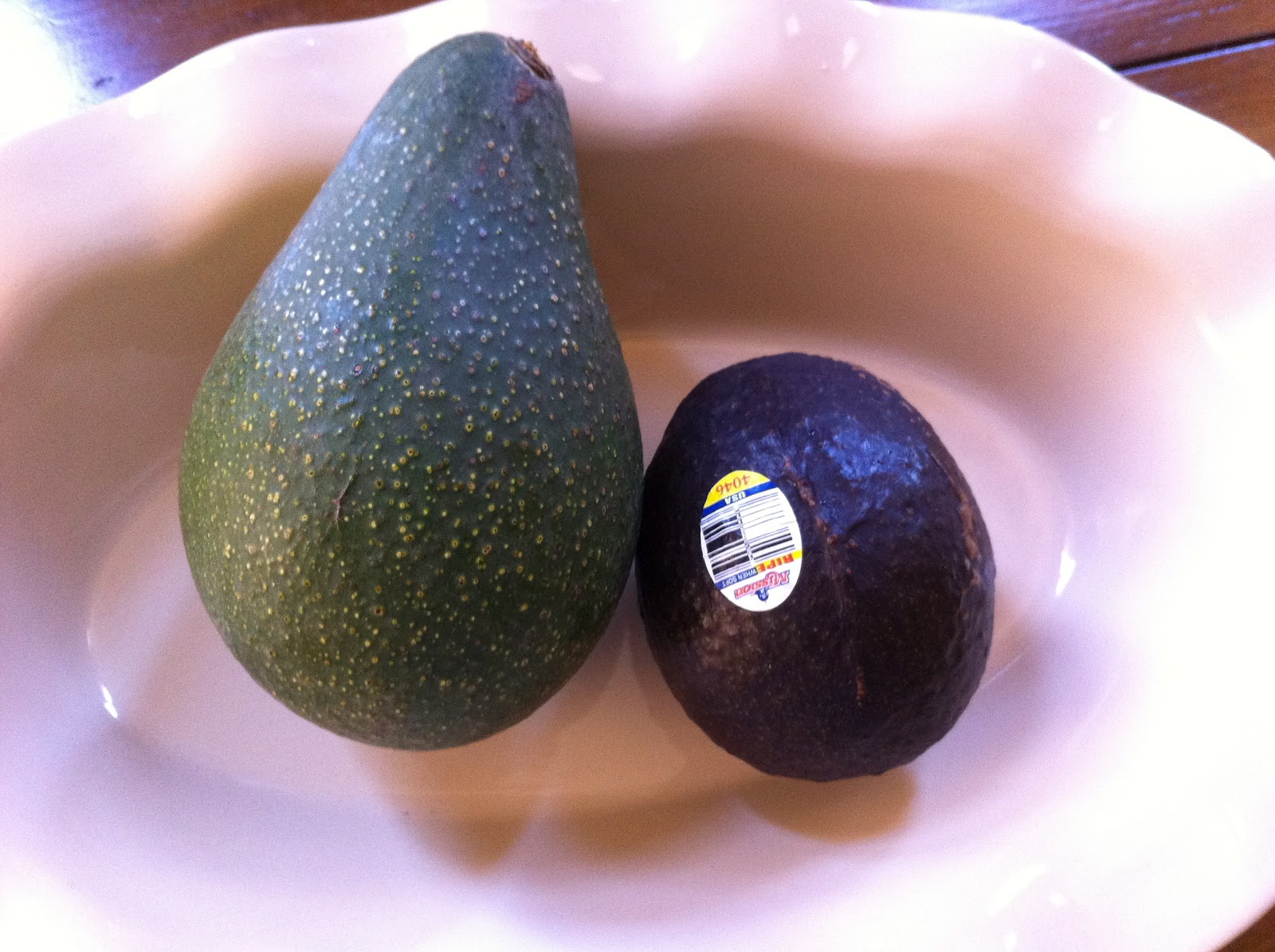 |
| A normal (yet large) winter avocado next to a normal sized Hass |
In short, the answer is NO... not yet (as of June 2012).
Here's the longer answer....
A. GMO means: "A genetically modified organism (GMO) or genetically engineered organism (GEO) is an organism whose genetic material has been altered using genetic engineering techniques. These techniques, generally known as recombinant DNA technology, use DNA molecules from different sources, which are combined into one molecule to create a new set of genes. This DNA is then transferred into an organism, giving it modified or novel genes. Transgenic organisms, a subset of GMOs, are organisms that have inserted DNA from a different species. GMOs are the constituents of genetically modified foods."
B. Avocados - like most agriculture - has been hybrid throughout generations to make the fruit more and more desirable for consumption and for marketing. The "original" avocados found in South America were tiny, had huge pits and not too much flesh. They sometimes had edible skins and often the leaves and bark were edible too - or at least useful as medicines or as a spice/flavoring. You can see a descendant of an original avocado, with a thin edible skin, and it's fresh & dried leaves below.
 |
| A "Mexicola" avocado with it's leaves (used like bay leaves) |
D. An example - to make the pit smaller, to make the skin tougher, to make the fruit sweeter or nuttier, etc. As of today, there are over 1,500 varieties of avocados throughout the world. In California - we have over 500 varieties! The most "common" or well known is the avocado called the "Hass". (So - just because an avocado is small or HUGE does NOT mean its a GMO... just FYI). Please visit my website www.AvocadoDiva.com to see and order many of these varities.
E. The Hass was also the first avocado with a patent. 85% of the fruit sold in the USA is a Hass. The Hass is a great avocado for the packing houses and the grocery stores - as it has several characteristics that make it ideal for picking, packing, shipping and display - most notibably that is has a thick (but not too thick), rough skin that turns black as it ripens. Thus the consumer knows its ready to eat AND it can handle the rough conditions of packing, shipping, handling and display. It is also very tasty. But is it THE best avocado? Not in my opinion ;-) I do love Hass at the height of it's season (June, July, August) -- but other varieties are more delicious at the height of THEIR seasons (you can visit www.AvocadoDiva.com for more info on that).
F. Finally -- there HAVE been attempts to create a GMO avocado - that would better resist the funguses that cause the most damage to the trees. Those attempts have not worked out (yet). At the present time, there are NO GMO avocados or avocado trees being sold or marketed. There are FALSE reports on the internet (usually about the Florida variety of avocado - marketed as a "Slim-cado"). The Slim-cado is simply a different variety - huge, bright green and very watery - that has grown in Florida for decades. These types of "watery" avocados are known the world over - and often used in desserts, shakes, and such (e.g. - in the Philippines and Brazil these types are more common).
G. If and when a GMO avocado comes out -- it may be in India (first) -- they seem to be the most interested in the attempts. The scientist who WAS working on it in the USA (in Florida) gave up in 2008. I have personally talked with 2 of the world's experts on this matter (in May, 2012) - who run the world's largest avocado tree nursery (for commercial - e.g. farms) in the world. They both said there are no GMO trees in production. They said they had hopes in the early 2000s - but have only seen failures -- and went back to the "old fashioned" grafting and hybrid methods and are now happy about that - given all the mixed results and bad publicity and news about GMOs.
I'd love your input and comments! I am personally SO happy that my beloved fruit is (so far) GMO free. The Avocado Diva (you can follow me on Facebook if you like!).
Thursday, May 24, 2012
Which Avocado is the BEST?!
 |
| Reed, Hass and Lamb varieties |
 |
| Various heirloom tomatoes at the local farm |
a. Which avocado is the BEST?
b. What is a "heritage" avocado?
c. What is your favorite avocado?
d. Which one should I buy?
So here's some answers for ya.....
a. The BEST avocado is the one that is in season.
b. A "heritage" avocado is like an "heirloom" tomato.
c. My favorite avocado is the ripe one.
d. You should buy the Avocado Diva's in-season heritage avocado.
To get them - join my Diva club and I'll get them shipped out to you each month!
Easy Peasy.
Love- The Avocado Diva
www.AvocadoDiva.com
Friday, May 11, 2012
Real Food Doesn't Need a Label

I think that this graphic just about says it all.
It was made by Pepper Culpepper of http://talesfromthedarkroastside.wordpress.com
(She was very kind and made it for me one day!)
But if this heritage avocado DID have a label - here are some of the wonderful things it might say:
KIND OF AVOCADO: A rare "Matthew Davis" (click on link for more info about how the Avocado Diva and fans are saving these rare trees!).
SIZE OF AVOCADO: 1 lb
ORIGIN: Ventura, California
NUTRITION: (from the California Avocado Commission)

Ever MORE amazing is how low in fat an avocado serving can be when compared to things like butter, sour cream mayonnaise or cheese!
Check out these stats - and then substitute a couple slices of avocado INSTEAD of butter or cheese and save HUNDREDS of calories!

If you'd like to have delicious, right off the tree, in season heritage avocados shipped to you each month - please visit our site and join our "Diva Club"! Thanks.
Subscribe to:
Posts (Atom)