Thursday, April 19, 2012

What was THAT noise?!

The Sounds of an Orchard

Have you had the sheer joy of walking through a fruit orchard? Walking in a straight line – with towering trees on either side – clear blue skies seen in bright, glorious stripes overhead? It’s an amazing sight – but even MORE so – it’s an amazing SOUND. 

Walk with the Avocado Diva – and HEAR with I hear…

First you notice the wind – sometimes whispering through leaves. Then it might rattle a few boney limbs of trees that need to be pruned. Every once in a while – a gust of wind will burst through – and the trees will make a chorus of sounds – raspy gasps of leaves and branches straining to hang onto their trunks – a grunt here and there with squeaks of protest from the larger limbs.


Once you get used to the almost spooky nature of the wind – you notice the sound of bees. There are ALWAYS bees in fruit orchards.  Avocado orchards have something blooming almost year ‘round. The “alternate” pollinator trees may be in full bloom – while the dominant trees are not. Or if you are very lucky – its full bloom time for the Hass – and the bees are making a MASSIVE sound. A hum that can almost overwhelm you with it’s sensory overload. Your primal brain fears the threat of that hum. On those days, I don’t dare to part the leaves and peak inside the trees – looking for the green pears that drip from the branches deep inside the trees. Best to leave it alone – and leave the busy bees to their work.


Next – if you pay attention – you’ll notice the crackling of leaves under your feet. Most avocado orchards are carpeted in dry, brown leaves scattered in thick layers along the rows and encircling the trees. The dry, crunchy leaves blanket the ground, keeping in the expensive, precious water so hard to find in the desert of southern California – but so critical to growing these subtropical fruit. Crunch. Crunch, Crunch – your boots help pulverize them into smaller, more decomposable pieces. Like a child – once you are aware of the leaves, you want to stomp on them and hear the crunch. Taking joy in the fun of mashing them and hearing them snap and pop! 

Again – if you are very, very quiet and stand quite still – you will hear wildlife. The screech of a red-tailed hawk or two – high overhead…. circling on the thermals – fighting over mates and territory.  The raucous crows will caw-caw and make that horrible crow “gurgling noise” that sounds like African drums - cawing in a staccato that makes you grow goose flesh and shutter.  

Quieter and quieter now – if you stand really still – you’ll soon hear the scurrying feet of small rodents and reptiles in the dry, crackling brown carpet of leaves. Quick – hurried feet most likely mean a squirrel or a rat! Tiny sounds could be a lizard or a mouse. The sound I most dread – the steady, constant rattle of the leaves – is a snake. Their long, lithe bodies make a long, constant “hiss” of moving, dried avocado leaves. It makes me shutter – and quake. It’s because of them that I always wear boots in an orchard. Finally – coming out of my fear… I can move again as the hiss fades away from me. 

Crouching down now, to try and stay absolutely still: I hear another very low but constant sound. The sound of water – squeaking and shushing out of hundreds of tiny, constant drip feeders. Avocado trees love water – but they don’t like swampy roots. So water is given like an “IV” – in a constant, slow drip – hour after hour. 
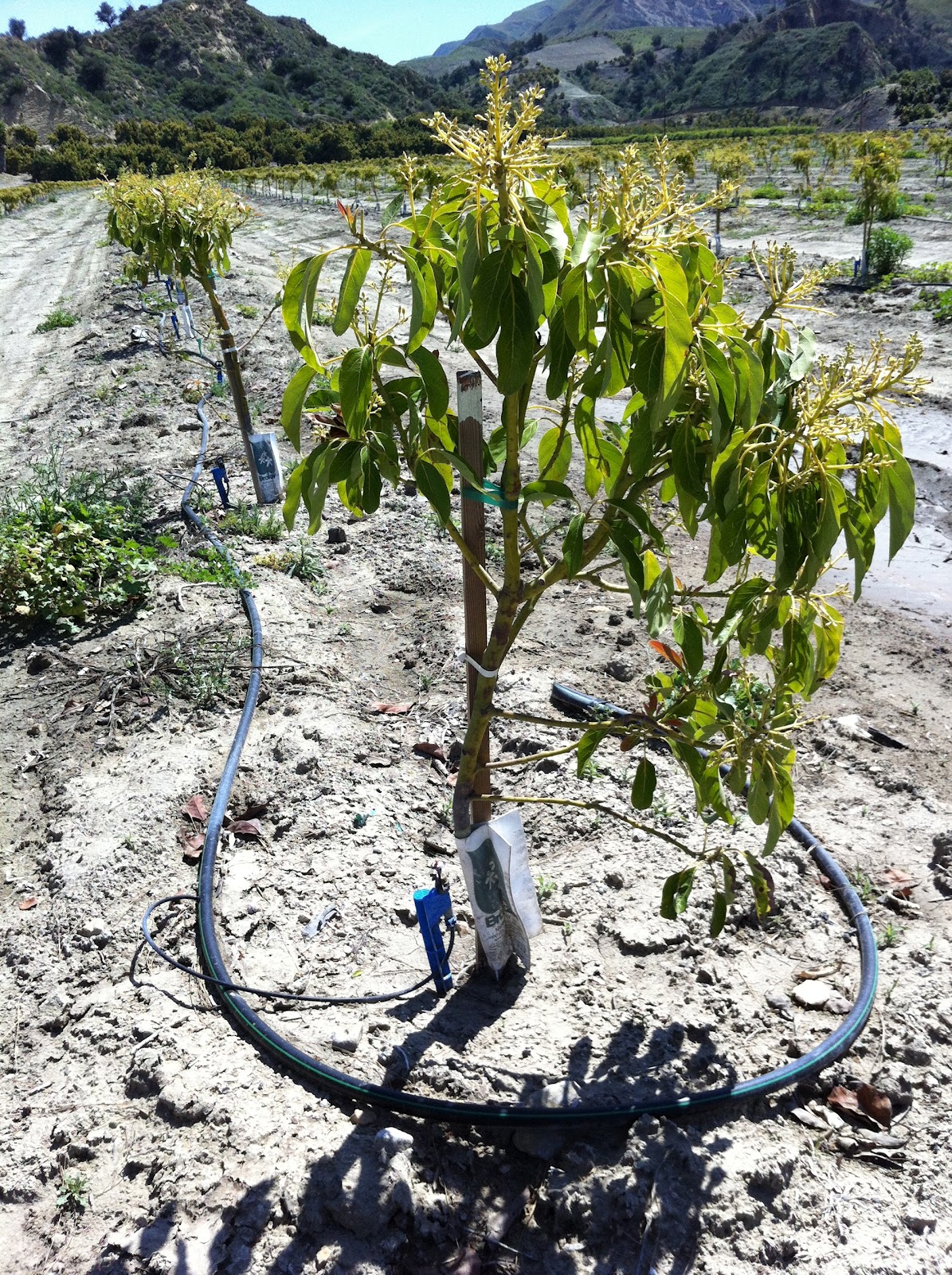
Now – with patience and a keen ear and a bit of luck you’ll hear the clip-clip-clip of another thirsty creature – the coyote.  Again – the light, steady “crunch, crunch, crunch” sound of a critter coming through the bone brittle leaves – this time a four footed fellow. Greedily – he is too impatient to lick from the slow dripping black water valve, he uses his canines – and rips open a gash in the black tubing that snakes through the orchard bringing water to each tree. The precious life blood of water pours our uselessly in the middle of a open area – he drinks his fill – then lopes away – head down – aware I’m there – but not caring. Almost smiling at how he steals the water and makes the rancher angry with his greedy destruction. 

I carefully ease up from my crouching position – adding a new noise – the creaking of my own knees ...and walk out of the orchard as quietly as I can. 

Thursday, April 5, 2012

What Avocado Tastes Best? (Seasons of Avos)

People say - Hass tastes the best - What does the DIVA say?! 

Heritage avocados grow YEAR ROUND in California -- so here is a list of what kinds are ripe - in which months.

What this means to YOU is -- what month(s) should you steal that avocado from a neighbor's tree -- no wait -- that's not right.  ;-)
This avocado is REALLY full of oil - you can see how creamy it is. If flesh sticks to the pit - its usually a good sign...

What it means is -- in California -- Hass are BEST in summer and early Fall.  Even I eat Hass during the summer as they are very delicious.  For all the other months, here is the Diva's preferences:

January - Bacon , any lonely - late season Lamb or Hass (still on a tree?!) 
February – Bacon or Zutano
March – Bacon, Santana, Fuerte, Steward, Zutano
April – Fuerte, Bacon, Pinkerton
May – Rincon or Pinkerton
June – Edrinol or Pinkerton 
July – Lamb, Hass, Reed, Nabal (if you can find any!)*
August – MacArthur, Hass, Lamb, Nabal*, Reed, Lady, Daley, Mattew Davis
September – Frey, MacArthur, Reed, Nabal*
October -  Late season summer varieties if you can find them, , late Mexicola, Morro Bay Hass
November – A hard month... :-(    The Diva goes into mourning -- may eat an import 
December – Bacon avocados, San Diego Zutano


You MUST eat the right avocado in (or after) it's correct season - otherwise they can be rubbery, watery, or (if they are too early) they shrivel - because they do not have enough oil in them yet. 

Avocados don't start to ripen until you pick it off the tree. Then they ripen up in 7-10 days - depending on their oil content. The later in their season - the more oil - the more quickly they ripen (it still takes at least 5 days). 

Once an avocado is in season - say a Fuerte comes into season in spring (April) - it can "hang" on the tree for up to 18 months. And all that time, its filling up with oil. So if you can find a "late season" avocado - like a Fuerte that is STILL on the tree in June or July or the winter!  -- it will be VERY OILY and delicious!  Very heavy and quite flavor-full. (And yes, they can go rancid. If you find an avocado on the ground, that is ripe, mostly likely it will have bite marks on it - because it FINALLY go SO full of oil a rat or squirrel nibbled on it.)

REWARD FOR READING MY BLOG: (You should follow the Diva on Facebook - because whenever I get a GREAT avocado - like late-season ones, or the ever elusive Nabal - I eat it. Then I put a notice on Facebook that I have some for sale - and they sell in hours!!  If I get a LOT of great avocados - they always go to my Diva Club members first.) 

One of my VERY favorite avocados is the "last of the season" Hass from orchards in Morro Bay, California - they hold an avocado festival up there in September. PLUS it's almost in Northern California (whereas the Diva lives in Central Coast -- and San Diego/Fallbrooke are South - almost in Mexico).  So what THAT means is that avocados ripen FIRST in the South (San Diego) then move up (Orange County, LA county, Ventura County - then up to Santa Barbara and finally the north - e.g. -- Morro Bay).  

When all the Hass are gone from down south and even in the Diva's area -- the Morro Bay avocados are still ripening -- and hanging on the trees.  It's SO worth it to go up there in September or October and buy their late Hass!  They are still oil filled and creamy and amazing! *Drool*

In any case -- you probably didn't want to know THIS much info -- but here it is. Enjoy!! 

And it you want to take all the "guess work" out -- OR you don't live in California -- why not join my Diva Club and let US find the best avocados, in season, and ship them right to your door each month? 

* Nabals -- yum. They are very rare. And considered a "rancher's secret". They don't like to sell them. They eat them themselves and hoard them for friends and family.  If I am lucky enough to get a Nabal -- I usually ship them to my Diva Club members first.  (Or I hoard them....).
This is a terrible picture of a Nabal - but it tasted GOOD.  They are very round, hard skinned and SO AMAZINGLY TASTY!!  One guy on Facebook offered me $10 per avocado. But I ate it. ;-) 

Monday, April 2, 2012

Why does my avocado turn brown?!

An amazing Fuerte avocado - this is after 1 hour
One of the most common questions that the Diva get's is:
"Why does my avocado (or guacamole) turn brown?"

Answer -- to get to the other side!!  ha ha

Oh wait, wrong answer.

Correct Answer: Avocados "oxidize" when they are exposed to air. Just like an apple or a potato.

Here are several ways you can keep your avocado from going brown too fast:

  1. Use an acid on the flesh (lemon juice, lime juice are often used). 
  2. Use a non-metal knife to cut the avocado (ceramic, plastic or teflon coated). 
  3. Eat a really fresh avocado (like my heritage avocados!)
  4. When done, store with a tight fitting plastic (wrap or tool). 
See the picture of the avocado above? Would you believe I set it out for over an hour with out treating it? I cut it up for my daughter's lunch - but then got sidetracked - for an hour. 

I was AMAZED when I came back and saw how little it had "browned"!!  But then again, my Avocado Diva avocados are REALLY fresh. They don't travel thousands of miles from another (3rd world) country. They don't sit in refrigerated trains or semi-trucks. They aren't "gassed" to get them to ripen. 

Order a box and try them for yourself!  www.AvocadoDiva.com

Monday, March 12, 2012

Green = Most Vitamins and Minerals

Lamb - note the darker green flesh next to skin
If you want to get the MOST vitamins and minerals out of your avocado - then follow this simple trick:

Make sure you get all the deep GREEN flesh! 

That's right, either
PEEL your avocado's skin
or
SCRAPE the skin with a spoon

The deeper the green color, the more vitamins and minerals in that part of the fruit's flesh.

If you have a winter avocado (which are typically thin-skinned) or a green avocado - those are usually best peeled. Winter avocados are also known as "greens" because they often don't turn black as they ripen. These varieties include Bacon, Zutano, Santanas and more.

Some avocados are "in between" - they ripen in spring and have green skins with some bumps - so you could peel or scrape. These varieties include Pinkertons & Gwens.

One exception is the Mexicola avocado (ripens in summer) - they are VERY thin skinned and are almost purple/black. The skin is SO thin and delicious, you can eat it! Kind of like a plum.

If you have the summer type of avocado (like a Hass, Lamb, MacArthur, Edrinol) they have thicker, bumpier skins and you can usually scrape out the flesh with a spoon.

Some avocados have REALLY thick skins (e.g. - the Reed or Nabal) and you can even use the empty skin like bowls. In fact, those varieties are SO thick skinned that you cannot tell they are ripe by squeezing them - you need to push on the stem (like a cantaloupe) to see if it moves or "gives" -- and that's how you can tell if these very round, large, hard-skinned avocados are ripe.

To see all the types of varieties mentioned here - please visit www.AvocadoDiva.com

Members of our "Diva Club" automatically get the in-season variety shipped to their home each month. It's a great way to support small farms and ranches PLUS get a wonderful variety of avocados shipped to you that you will NOT find in your grocery store. Hope you will consider joining us.

Monday, March 5, 2012

Wakey Wakey - Eggs and Bacey (Bacon Avocados!)

Can I just share that I live in paradise?    No?  Too bad... ;-)  Keep reading for the recipe...


Can I just share that I live in paradise? This is a photo of a sunset (I wanted you to think its a sun rise - but seriously -- the Diva does not get up that early) from my neighbor's porch. It's actually my sister's porch (who is also my neighbor) - so how lucky is that?

Anyway - it's sunrise (as far as you know) - so it's time to cook some eggs and BACON! Bacon avocados that is. This is so easy.

1. Cut a Bacon avocado in half and de-pit. The cut out 2 nice slices (see photo) from each half (so you have 4 total).  (Save the "butt" pieces for something else - or just eat them. YUM!) Be sure an peel the pieces too.

2. Heat up some avocado oil (or EVOO if you are not lucky enough to have avocado oil).

3. Sprinkle the Diva's Guacamole spices mix on the avocado slices and slide them into the hot, oiled pan.

4. Immediately crack an egg into the avocado's "pit hole" (no crude jokes necessary here...). Add a pinch more Guacamole Spice mix.

5. Fry until firm - then flip over. Add another pinch of spices and cook for another minute or two.

6. Slide onto a plate and enjoy!

It's delicious with a side of tomatoes or salsa. Bacon avocados are available in the winter time. They are quite large and full of oil making them creamy and delicious.


Friday, February 17, 2012

How YOU Helped Discover and SAVE an Avocado Variety!

This is the tree "we" helped save -- well, actually the tree will probably not be saved... but the avocados it produces will live on and on...This is the story and a bunch of cool photos follow at the end. 

Last summer (August, 2011) a story came out in the Ventura County Star (our county's largest newspaper) about the Diva and her love of rare, unique, "heritage" avocados and the trees they grow upon. A very nice man emailed the Diva to say his mom had a tree that was very old, produced some amazing avocados, and that soon the tree would probably have to be cut down. He wanted to know if the Diva had any ideas for how to save the avocado tree.

I exchanged several emails with Mr. Davis and suggested a couple of ideas:

a. He could contact the internationally known nursery that grafts most of the commercial avocado trees for all of California, Brokaw Nursery. It just so happens that they are in the same town as his mother's house and tree!

b. He could also contact the commercial nursery that grafts trees for the consumer market - LaVerne nursery, which is also in Ventura County (in Piru, California).

It turns out that Mr. Davis had already worked with a couple of exotic fruit growing hobbyists to take scions and make grafts. Mr. Davis had attempted to do that too -- but with little luck. So it turned out that Brokaw Nursery was kind enough (and interested enough!) to send a professional out. Mr. Davis called him an "avocado whisperer" - he checked out the tree, spent quite a bit of time observing it, looking at it's leaves, it's bark, and finally took several cuttings (in late November) when he determined it was at the optimal time to produce budwood that would graft well.

In January (2012) -- Mr. Davis' mother passed away -- and it was time for the family to sell the old family home. The tree will probably have to be cut down - as it is very old, very large, and towers over the home - making it not easy to insure (plus there are several other issues).

Avocado trees don't move well - it's not like you can dig it up (the root system would be several dozen feet wide, for one thing) - plus they just stop producing fruit after several decades.

The great news is -- in February -- Brokaw Nursery called Mr. Davis and (yippee!!) the grafts worked well! They had several small trees growing - and Mr. Davis was SO kind - he gave the Diva one! Mr. Davis and his family will all attempt to grow them, as well as several other friends. So this tree will live on through the traditional process of cutting, grafting, and growing more "baby" trees - just like we've been doing in California since the Spanish landed near Dos Pueblos (above Santa Barbara) since the 1800's.

I plan to grow my tree inside my house for a couple of years in a large pot -- and when it gets larger and stronger - then I will transplant it and grow it on the hill in my back yard.

Thanks to you (seriously) - for encouraging me, for following my blogs, for responding to my Facebook posts, and for purchasing the Diva's avocados, tools, spices, etc. Because of "us" -- you are helping me preserve these grand, old trees and these fabulous heritage avocados. Please check out the photos below - as they help tell this awesome story.

The Davis Family home in Ventura, California - tree on the right

The tree was probably planted in about 1930 - the home is now surrounded by industry (oil firms, warehouses) and a few apartment houses. It will most likely be sold and torn down to be replaced by something similar. 

This is one of the avocados from the tree - the family got to name the variety (which is traditional). Mr. Davis named it for his grandson, Matthew Davis.  I took this photo on a local beach in Ventura. 


Here is one of the nursery's tag's for a scion, noting the newly named variety's name (Matthew Davis), where it came from (Ventura) and the date the scion was cut. 

Here is my little tree along with one of the immature fruits from the "mother tree". (Feb 2012)


Why Won't My Avocado Ripen?!

A variety of California Avocados - 3 winters and 2 summers

So the avocados above were all picked during the winter - but two of them are not winter avocados. Who cares? You may -- read on to find out why one is going to be SUPER delicious and one will NOT be.

So here's what they are named (from left to right):
a. Pinkerton
b. Bacon
c. Lamb
d. Fuerte
e. and the "big guy" in the front is a newly named avocado called a Matthew Davis.

The Lamb and the Matthew Davis are both summer avocados. So how can you have a summer avocado in winter time?  There are two ways:

1. The Lamb was "overlooked" when the pickers picked this orchard and left a few of the Lambs on the tree - way, way up on the top branches. Avocados can "hang" on a tree for many, many months. They don't ripen until they are picked or when they fall off the tree. So finding a few avocados (especially Lambs, Hass or Edrinols) left on a tree is a special treat. They just keep adding oil and get yummier and yummier. (But if they are left too long - they can go rancid... so its a delicate balance here...).

2. The Matthew Davis is the opposite - it was actually picked in February -- but it isn't ready to be picked. If you can believe it, this avocado is only about 1/3 to 1/2 of the size it will be when ripe. It grows HUGE. It is also not ready to eat, because its oil content is too low. The flesh will never really ripen. It will slowly shrink along it's ridges and just rot. When avocados are picked too early, they just get wrinkly (usually from the top down) and stay rubbery.

So now you know! California avocados, all 500 varieties of them, grow year 'round here in the sunshine state. You do need an expert to help you know when they are ready to pick. You can find some of that info here at the Avocado Diva's website and by following me on FaceBook or this blog! Thanks for reading.

(P.S. -- If you'd like to find out more about the amazing Matthew Davis -- and how the customers of Avocado Diva helped save this variety - click on this link to read that blog story.)